
You turn on the AC for the first time this summer, and something’s off. Not broken exactly, just musty. A faint dusty smell drifts out of the vents every time the system kicks on.
Maybe you’ve noticed something else too. One room never quite cools down like the others. Or your energy bill crept up again, even though nothing’s changed.
These are the quiet signs of dirty ductwork, and most homeowners don’t think about their ducts until something like this nudges them to.
The good news is that ductwork is fixable. Sometimes a thorough DIY cleaning near the vents does the trick. Other times, it calls for a professional deep clean that reaches parts of the system you can’t get to on your own.
Ahead, we’ll cover what builds up inside ductwork over time, what you can safely tackle yourself, the signs it’s time to call a professional, and what that professional cleaning actually involves.
Table of Contents
- The Basics of Cleaning Ductwork
- How Do You Clean Ductwork Yourself?
- How To Clean Ductwork in 6 Steps
- Is DIY Duct Cleaning Enough?
- Why You Should Choose Professional Duct Cleaning From AAA Heating & Cooling
- Commonly Asked Questions About Cleaning Ductwork
- AAA Heating and Cooling: Portland’s #1 Choice for Residential Air Duct Cleaning
The Basics of Cleaning Ductwork
“Duct cleaning” is a bit of a misleading name. The ducts themselves are only part of the picture. The EPA defines duct cleaning as covering the entire forced-air system, including the coils, drain pan, vents, grilles, air plenum, blower motor, heat exchanger, and filter, not just the ductwork running through your walls.
Think of it like cleaning your kitchen. You wouldn’t wipe down the counters and call it done while leaving the stove covered in grease. Skipping any part of the system means dust and debris can just work their way back in.
Skip a step, and you’re not really solving the problem. Dust that gets stirred up but never collected just resettles somewhere else in the system, sometimes in a spot that’s even harder to reach next time.
A full cleaning comes down to two basic steps: loosening what’s built up, then collecting it before it spreads.
Loosening Contaminants
Dust and debris don’t just vacuum away on their own, especially once they’ve settled onto duct walls. Professionals use tools like brushes, air whips, and compressed air nozzles to knock loose material free. For lighter buildup, hand brushing or targeted vacuuming can do the job.
Collecting Contaminants
Once contaminants are loosened, they need somewhere to go besides your living room. Professional equipment creates negative pressure throughout the system, essentially a controlled vacuum, so dust gets pulled out and collected rather than pushed further into your ductwork or blown into the air you breathe.
How Do You Clean Ductwork Yourself?
You can clean the parts of your ductwork you can safely reach, mainly the vents and the areas just behind them, using a shop vacuum, a screwdriver, and some warm soapy water. Deeper sections of the duct system typically require professional equipment to clean thoroughly.
Here’s a quick preview of the process before we walk through each step:
- Gather your tools
- Prepare the area
- Remove and clean vent covers
- Vacuum the ducts
- Clean the furnace
- Restore your system
How To Clean Ductwork in 6 Steps
Ready to get started? Here’s what a DIY duct cleaning actually looks like from start to finish.
#1: Gather Your Tools
Before you get started, round up all the tools you will need for the job, including:
- A shop vacuum with a hose attachment
- A screwdriver
- Warm water and mild dish soap
- A soft brush or microfiber cloth
- Drop cloths or old sheets
- A flashlight
- A replacement air filter
- A dust mask (this gets dustier than you’d think)
#2: Prepare the Area
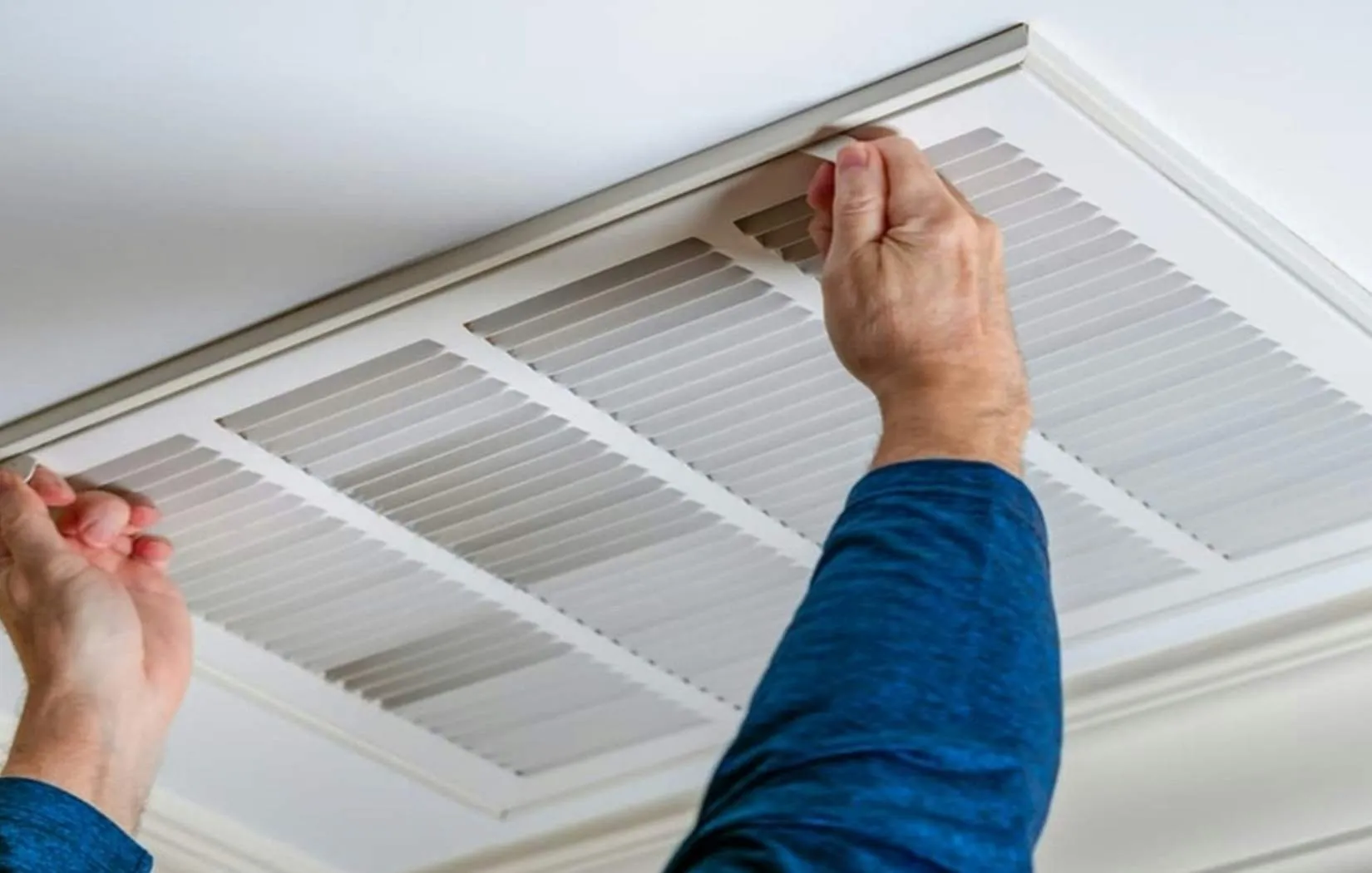
Turn your thermostat to the off position so nothing kicks on mid-cleaning. Lay drop cloths under your vents to catch falling dust and debris, then use your screwdriver to remove the vent covers.
This is a good time to mention: those vent covers actually have a proper name. HVAC pros call them registers. You’ll usually hear “supply registers,” which push conditioned air into a room, and “return registers,” which pull air back into the system. Return registers tend to be the dustiest of the two, since they’re constantly pulling room air back in.

#3: Remove & Clean Vent Covers
Wash the registers in a sink or bucket with warm, soapy water. A soft brush helps work loose any stuck-on grime in the slats. Let them air dry completely before moving on, since putting damp registers back on can invite mold.
#4: Vacuum Ducts
Extend your shop vacuum hose as far into the open ductwork as you safely can, then slowly pull it back to draw out loose dust and debris. For stubborn buildup, a flexible rotary brush attachment can help knock things loose first. Always work toward the vacuum nozzle so you’re pulling debris out, not pushing it deeper into the system.
#5: Clean the Furnace
Remove the front access panel on your furnace to reach the blower compartment. Carefully vacuum around the blower wheel, watching out for any wiring or delicate components. While you’re in there, swap your old air filter for a fresh, high-efficiency one to catch any dust you just stirred up.
#6: Restore Your System
Reattach the registers once they’re fully dry, then switch your thermostat back on. Give it a few minutes and see how things feel. A noticeably fresher smell is a good sign your cleaning made a difference.
Is DIY Duct Cleaning Enough?
A DIY cleaning is genuinely useful. It clears out surface dust near your vents and can make a real difference in day-to-day air quality. But it has limits.
Most of your duct system is hidden behind walls, floors, and ceilings, well beyond where a shop vacuum hose can reach. Allergens, mold, and years of accumulated debris can settle deep inside the system, often in spots that also affect efficiency. Leaky or heavily obstructed ductwork can reduce a heating and cooling system’s efficiency by as much as 20 percent, according to ENERGY STAR, which helps explain why that energy bill might be creeping up even though nothing else in your routine has changed.
There’s also the question of what you can’t see. Mold growth inside metal ductwork, for example, needs to be physically removed, not just masked with an air freshener or a new filter. Trying to guess at what’s happening deep in your system usually costs more time than it saves.
For a deeper clean, and a clearer picture of what’s really going on in your system, it’s worth bringing in a professional.
Why You Should Choose Professional Duct Cleaning From AAA Heating and Cooling
Here’s what a professional cleaning with our team actually looks like:
- Connect the equipment. We attach a hose to the plenum, where your ductwork meets the furnace, linking it to our truck-mounted collection system.
- Create negative pressure. Registers get covered, and our equipment engages, pulling debris out of the ductwork and straight into the truck instead of into your home.
- Flush each register. Using high-pressure compressed air, we clear debris from each vent, pushing it back through the ducts and into collection.
- Break up stuck-on buildup. A flexible tool reaches further into the ducts to loosen dust and grime clinging to the duct walls.
- Finish the full system. Our technician wraps up by cleaning your HVAC fan, fan compartment, heat exchanger, and coils where accessible, so the whole system gets attention, not just the ducts.
This complete process, done every 3-5 years, can extend the life of your HVAC system.
Commonly Asked Questions About Cleaning Ductwork
How Often Should I Clean My Ductwork?
Most homes benefit from a professional cleaning every three to five years, though your household might need it more often if you have:
- Pets that shed
- Smokers in the home
- Family members with allergies or asthma
- Recent renovation or construction dust
- Visible mold inside the ducts
That last one is worth flagging on its own. The EPA specifically recommends professional cleaning if there’s substantial mold growth, a pest infestation, or ducts so clogged that debris is visibly blowing into your home.
Mold isn’t just an eyesore either. The CDC notes that exposure to mold can trigger allergic and asthma symptoms in sensitive individuals, which is part of why it’s treated as a must-clean trigger rather than a wait-and-see one. Everyday dust around a return register, on the other hand, is normal and usually just needs a quick wipe down.
If you’re not sure where your ducts actually stand, a professional inspection can give you a straight answer instead of a guess.

Are Chemicals Required for Duct Cleaning?
Not usually. Antimicrobial products like sanitizers and deodorizers are sometimes used to address odor or microbial growth, but only after mechanical cleaning is done and only if it’s actually needed. Any product used should be EPA-registered, since not all cleaning chemicals are approved for HVAC systems.
How Long Does It Take To Clean Ductwork?
A full professional Portland residential duct cleaning takes our technicians at AAA a full day, since we need access to every part of your home’s system. We recommend not scheduling it alongside any other HVAC work or renovation project, and it’s smart to plan your day around it since it can affect your household’s normal routine.
AAA Heating and Cooling: Portland’s #1 Choice for Residential Air Duct Cleaning
That musty smell, the room that never cools down right, the energy bill that keeps creeping up. They usually trace back to the same place: ductwork that’s overdue for attention.
A DIY cleaning is a great first move, and it might be all you need. But when the buildup goes deeper than a shop vacuum can reach, or when you’re just not sure what’s actually going on behind those vents, that’s where we come in.
AAA Heating & Cooling has been a family business helping families since 1961, and duct cleaning is one of the things we take seriously precisely because we’re not going anywhere. We’re not swinging through Portland once and moving on. Our NADCA-trained technicians treat your home’s air quality the way they’d want theirs treated, because odds are, we’ll be back again in a few years for a checkup anyway.
If your ducts are past the point of a weekend DIY project, schedule an appointment with our Portland and Beaverton team. We’ll show you exactly what we find, walk you through the process, and get your system breathing easier.